Month: September 2023

  • Improving Your JSPS Research Fellowship (DC1, DC2) Application [Advice from a Successful FY2024 DC Applicant]

    The results for the JSPS Research Fellowships (DC1 and DC2) were announced at 14:00 on Wednesday, September 27, 2023.

    I was one of the students who applied, and I am happy to report that I was selected.
    Word going around on X (formerly Twitter) was that this year’s acceptance rate was lower than usual.

    Apparently the initial acceptance rate was around 14%, or about 17% including the second round of selections.

    I had heard that the rate is usually close to 20%, so when I saw the numbers my first thought was, “Seriously?”

    Through this application cycle I read a number of other people’s JSPS applications and wrote my own, so here I’d like to summarize the things worth keeping in mind to improve your chances even a little.

    I think this applies not only to JSPS applications but to grant proposals, job application essays, and any writing meant to be read by others, so I hope you’ll read on.

    What matters is what lies beyond the application

    First, the key to writing an application is conveying what you want to say within a limited amount of space.

    An application explains your research and argues for its importance: this is who I am, these are the things I can do, and therefore I can achieve this goal. So please fund me.

    In other words, you need to keep sight of what your writing is ultimately for.

    While writing, it’s easy to get caught up in immediate concerns—producing elegant prose, writing something your advisor won’t complain about—and lose sight of what an application fundamentally is.

    It isn’t self-satisfaction: there are people who read and evaluate it, and score it accordingly.
    That is what clearly distinguishes it from an exam, and it’s precisely why there is no single correct answer.

    My impression is that many people who have spent their lives taking tests with right answers suddenly hit a wall when faced with an application, unsure what to write or what counts as correct.

    Even while writing, you need to keep in mind who the application is written for.
    For that reason, writing a few applications to other funding bodies before the JSPS one and having people read them makes a striking difference in how readable your writing becomes.

    The keywords are “logic” and “specificity”

    Logic

    The two things I paid the most attention to when writing my JSPS application were logic and specificity.

    Logic means that your argument is consistent and that each topic connects to the next.
    You need to think about these connections at multiple scales: between sentences, between paragraphs, and across the application as a whole.

    To put it in more practical terms,
    logical writing is writing in which the reader finds what they want to know, in the order they want to know it.
    When this is done well, the content flows effortlessly into the reader’s mind.

    The point is to think from the reader’s perspective.
    No matter how logical you think your argument is, that logic may not land with your reader.

    Guides to writing JSPS applications often recommend inserting phrases like “in other words” or “the details are described below,” but the essential purpose of these is to give the reader signposts that make the connections in your text easy to follow.

    Opinions differ widely on whether such phrases are necessary, but one thing I can say is this: if leaving them out makes your structure unclear, put them in, even at the cost of precious character count.

    Specificity

    Specificity means, quite literally, providing exactly as much information as the reader needs.

    You’ve probably heard people say, about applications or research talks,
    “My research requires so much background that I just can’t keep it short.”

    I’ve thought the same thing myself many times before a ten-minute conference talk—there’s no way this fits in ten minutes.

    But even in a talk you’ve confidently packed with content, it often turns out that there was a lot of information the audience didn’t need and almost none of what they actually wanted to know.

    In other words, you haven’t decided what to keep and what to cut.

    To make those decisions, first determine the single thing you most want to convey.
    Then keep whatever is needed to explain that core point and discard whatever isn’t. That is how you achieve specificity.

    Applications like the JSPS one require you to describe your research and yourself in a genuinely tiny amount of text.
    People often say you should divide the JSPS funding amount by the character count of the application to calculate the value of a single sentence.

    I think the point of that exercise is to get you asking: is this sentence really worth that much money? If not, rewrite it.

    Background explanation is a third-person account, and while it’s necessary to make your own work stand out, the text itself describes other people’s research and is therefore low in value.
    Whether you keep it to a minimum or find some other value in it is up to you.

    Through this kind of revision, the content becomes refined.

    So far I’ve talked about specificity while only discussing cutting material, but the real point is to condense the content and raise the specificity of each sentence to just the right level—no more, no less.

    Throughout the process I kept logic and specificity constantly in mind, periodically stopping to reread and rewrite.

    Show it to others early

    One of the most important points is to have other people read your application early.

    Some people wait until it’s finished and they’re satisfied with it, then show it to someone a week before the deadline—but honestly, that’s a waste.

    Showing your draft to others is about confirming that you’re heading in the right direction and getting feedback, not just getting corrections.

    As people often say, the quality of a JSPS application depends on how many people have read it: you gain new insights, and sometimes your fundamental way of thinking changes.

    Ideally, aim to have someone other than your supervisor read it at least three weeks before the deadline.

    Don’t stare at your application nonstop

    When application season comes around, I often saw people put their experiments on hold to focus entirely on their proposals.
    It’s true that you need to invest a fair amount of time, and since you revise it over and over, it ends up eating up an enormous number of hours.

    That said, once you’ve written a decent draft, there’s no point in endlessly rereading it and burning time for nothing.
    In fact, you should leave the draft alone for a while before you go back and revise it.

    An application is an important document with your career riding on it.
    But it doesn’t get better in proportion to the time you pour into it. The real challenge is producing the best possible document as efficiently as you can.

    Rather than being glued to your computer, keep your experiments moving along, or even take a break to clear your head. You’ll write with a much cooler eye.

    I didn’t just write at the university; I would take my laptop to cafes and other places, changing the setting often as I wrote.

    Closing thoughts

    This year’s provisional acceptance rate is said to be around 14% at the first round of screening.
    Put another way, 86% of applicants were not selected for a JSPS fellowship.

    Since the vast majority of applicants aren’t selected, there’s no need to be more discouraged than necessary about not making the cut.

    At the same time, those who were selected got their place at the expense of many other people’s dreams and livelihoods.
    Of course, the selection reflects a real evaluation of your research as it stands, but beyond that, it carries the responsibility to work twice as hard from here on.

    I want to keep this in mind myself and keep pushing forward with my research.
  • How to Search for Papers in the Life Sciences [A Graduate Student’s Guide]

    Once you join a lab, chances are you’ll be asked to present a paper at a journal club sooner or later.

    The format of journal clubs varies from lab to lab, but in many cases you’re expected to find a paper yourself, read it yourself, and present it.
    Even outside of journal clubs, doing research means getting to know the prior literature, so you’ll be searching for papers a lot.

    Here I’d like to introduce some tools that come in handy for that.

    Google Scholar

    The first one is Google Scholar.

    It’s so well known that there’s probably not a single researcher who hasn’t heard of it.

    Basically you search just as you would on Google, but everything that comes up is literature—papers, books, and so on.

    Since it’s the tool you reach for when you just want a rough look at the literature, I suspect it’s the most widely used search tool of all.
    I use Google Scholar too: I throw in some rough keywords and use the results as a first screening pass.

    The flip side of being good for broad searches is that there aren’t many options for narrowing things down.

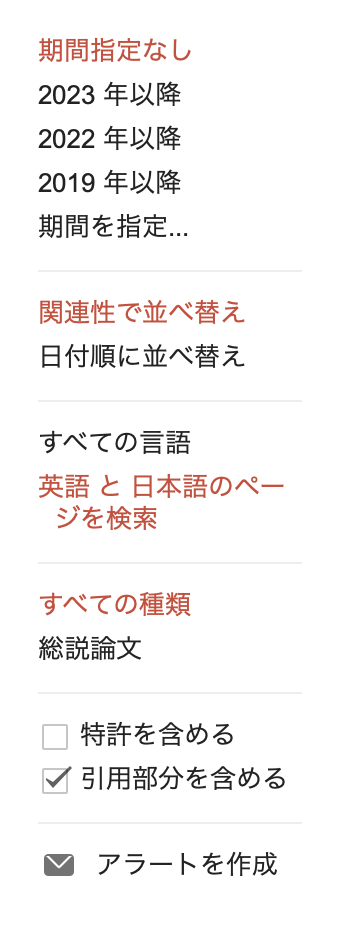
    Still, the main filters are there—publication date range, relevance, and so on—so it covers most needs.
    And when you want to restrict the search to a particular journal, you can just put the journal name in the keywords; it really works the same way as a Google search.

    PubMed

    The next one is PubMed.

    PubMed is probably the best-known literature search tool in the life sciences.

    What’s impressive about it is the sheer number of ways you can search.

    Author, journal, editor—you can search by just about any field you can think of.

    It’s an extremely useful tool when you already know the journal, the author, or whatever other details you want to search by.

    Web of Science

    The last one I’ll introduce is Web of Science.

    It’s a paid service in principle, but if you’re affiliated with a university you can generally access it through the campus wifi, so students can use it for free.

    Where this tool really shines is that it lets you look up what’s known as the impact factor (IF).

    The IF is a kind of journal ranking—a number that indicates how strong a given journal is.

    You can find impact factors by googling “journal name IF” as well, but the numbers you get are often not the official ones.

    Web of Science is the source that officially issues IFs, so you can find the correct value there.

    I use Web of Science as my IF lookup tool when deciding which journal to submit to, or when I want to gauge how impressive one of my advisor’s papers is.

    Closing thoughts

    Google Scholar is what I use most of the time, but knowing about the other tools comes in handy when you need to look something up in a specific way.


  • My First-Ever Hair Removal — in Korea!!

    Getting beard hair removal in Japan is, I think, extremely expensive.
    And the fact that you have to go back again and again is another pain point.

    In Korea, a country famous for its beauty industry, hair removal is apparently much cheaper than in Japan. I had never had it done before, but on my first trip to Korea I decided to try hair removal for the first time!!

    The Process and the Price

    I had the treatment done at Personal Beauty GU Clinic in Gangnam-gu.
    I made the reservation through the smartphone app Gangnam Unni.

    Here is the link

    I used Gangnam Unni to search for men’s beard hair removal in Seoul, but there were only one or two other places offering it, so choosing wasn’t hard at all.

    At the time of booking, the price was 500,000 won for five full-face sessions (about 50,000 yen).
    So cheap!!!

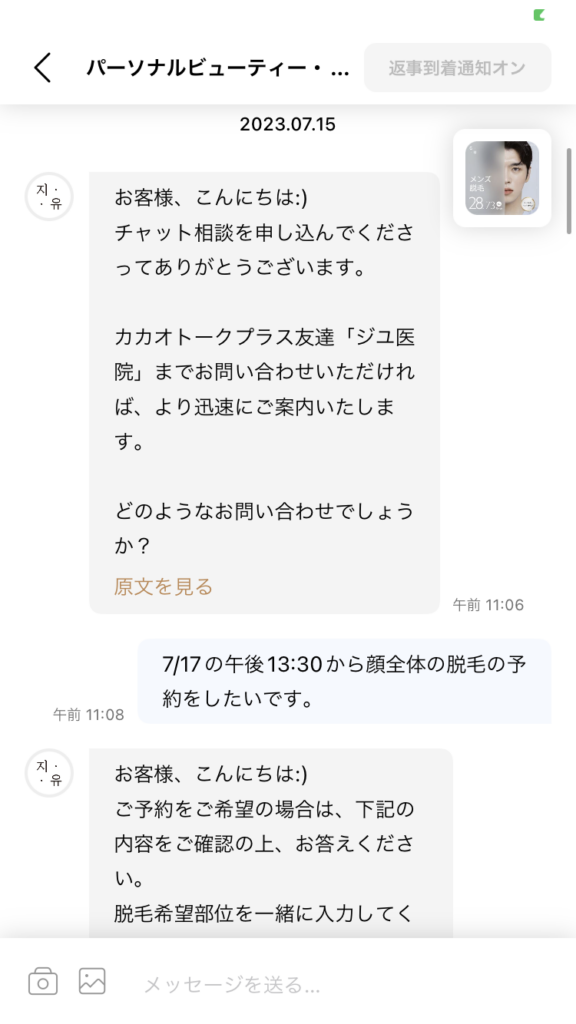
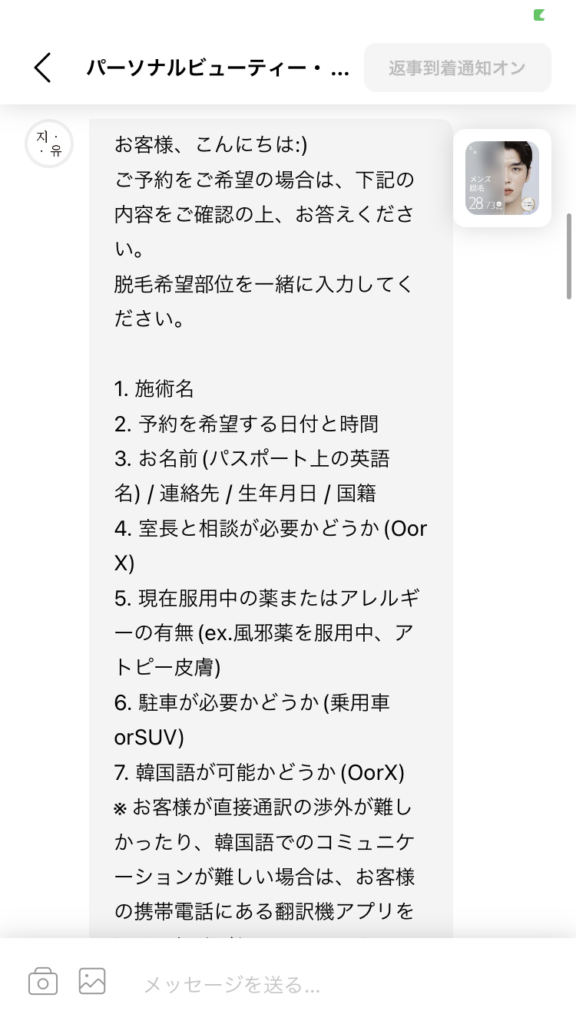
    Two days before, I applied for an online consultation through the app to make my reservation.

    The moment I tapped “online reservation,” a message came back in Japanese.

    The app seems to translate the Korean automatically, so I felt no language barrier at all in booking. The message also said that if communication proved difficult they would use a translation device, which gave me the impression that they’d be accommodating to foreign patients.

    So with that, I had my reservation, and on the day itself I headed to the clinic.

    https://maps.app.goo.gl/FjLBboA6a7Dvu6TT8

    When I got there, there were several other Japanese people around, which was a bit of a relief.
    Worst case, if something happened, maybe someone would help me out… right? lol

    I told the receptionist I had a reservation, was asked to wait, and sat down in a chair.

    But even though I arrived at my reserved time, I was kept waiting for about two hours before finally being called and taken to some mysterious private room.

    There, someone who seemed to be the doctor explained things to me using a translation device, and I paid.

    After that, I waited about ten minutes and was then taken further inside.

    A nurse told me she was going to apply anesthetic to my face, and she sprayed some liquid from what looked like an alcohol spray bottle onto my face.
    (It had a slightly sweet smell, so it probably really was anesthetic, lol)

    After a while my whole face felt a bit tight, and just as I was thinking the anesthetic must be kicking in, a fairly young male doctor called me into the treatment room.

    And then came the laser.
    Maybe because of the anesthetic, it barely hurt except where my beard is thick, and even there it only stung a little.
    It was different from the reputation hair removal has in Japan, so maybe the use of anesthetic is what sets Korea apart.

    That said, there was a strong burnt smell, and they kept blowing air on me the whole time.
    Just as I was starting to muse about whether the lasers are stronger here than in Japan, I heard “All done!”

    It honestly felt like about 30 seconds. I thought, wow, that was fast.

    After that I washed my face, headed out, and enjoyed the rest of my trip to Korea.

    The Results, Some Days Later

    For about a week, almost nothing happened, but by the second week I started noticing spots where my beard looked thinner.
    Actually, “not growing at all in places” is probably the more accurate description.
    I was genuinely surprised!

    The treatment really does seem to work!

    I can go back to that clinic four more times, and they told me to come at intervals of about a month and a half to two months.

    I figure I’ll just go whenever I can, tacking it onto future trips to Korea.

    Overall Verdict

    Apart from the absurdly long wait, I had no complaints at all. Communication was a bit halting, but with the ultimate weapon that is a translation device, every problem got sorted out.

    When I mentioned the long wait in a review, the clinic replied with an apology and said that it doesn’t usually happen on weekdays, so I should come on a weekday next time!

    Maybe I’ll go on a weekday from now on.

    It was a pretty interesting experience overall, so definitely give Korean hair removal a try.

  • Writing My First Paper: A Personal Account

    Writing papers is one of the most important things a researcher does—it is how research gets reported to the world.

    Writing a paper takes far more time than you would imagine; it is unglamorous work that demands real persistence.
    That is exactly why the first paper you write yourself leaves such a strong impression.

    I myself had the experience of writing a paper from scratch in my first year of the master’s program, under my supervisor’s guidance.
    It varies by field, but in biology it is quite rare for a master’s student to write the text of a paper themselves.
    After all, most students never publish a paper at all at that stage.

    I am grateful to have been given such a rare opportunity, and I want to write down that experience here so I don’t forget how it felt.

    The Time Scale of Writing a Paper

    In biology, it generally takes about a year from deciding to write a paper to actually seeing it published.
    It depends on the format and scale of the paper, but from my own experience, the big difference from fields like chemistry and engineering is the sheer volume of content a paper must contain.

    Unlike reporting the discovery of a compound or a protein, neuroethology—the field I work in—requires demonstrating something like “this neuron contributes to this behavior in this way,” so it is not at all unusual for a paper to have more than five figures (each containing multiple graphs).

    For that reason, gathering all that data, writing the paper, and getting it published is said to take longer than in other fields.

    Below is a rough outline of the steps leading up to submission.

    • Write the manuscript (1 month to over a year). All sorts of things can happen while writing, so it often doesn’t go smoothly.
    • Have others read the manuscript (1–3 months). This step happens sometimes and not others: you ask a colleague who isn’t involved in the project to read it and see whether the content makes sense.
    • English proofreading (about 1 month)
    • Submission!!! (2 days to over 4 months). A rejection can come back in two days, whereas if it goes out for review you may hear nothing for months.
    • Revision (1–6 months). You receive reviewer comments, add missing data, revise the content, and resubmit to the journal. Revisions come as major or minor, and you are often asked to make changes that alter the overall structure of the paper.
    • Acceptance!!! Once you have handled the revisions and the journal gives the green light, the paper is accepted. Only at this point does the work finally count as an achievement.
    • Formatting for publication (1 week to 1 month). This is the final round of work, getting the paper formatted for posting online or printing in the journal.
    • Publication, writing a press release, and so on. After acceptance, all kinds of things happen in quick succession and life gets busy.

    You don’t just write a paper and press a button to publish it. A paper is evaluated by many people, examined by third parties for logical soundness, and only then accepted and released to the world.

    My Own Experience

    First of all, the published paper is here.

    After giving my undergraduate thesis presentation in my fourth year, my supervisor suggested at the end of February that we write a paper.

    I started writing in March, submitted to the journal iScience in December, and the paper was formally accepted in April.
    It was published almost exactly a year after we decided to write it—an unusually smooth submission process.

    That March, I was thrilled to be told we would write a paper, and I was determined to finish it as fast as I could.
    But even though I was told to go write it, I had no idea how, so I looked up published papers and imitated them as best I could while writing up my own results.

    My English was weak, which didn’t help, and I kept getting sent back with “I don’t understand this—please fix it.”
    Rather than being handed a corrected version, I was told which parts were unclear and asked to rewrite them myself. At the time it was genuinely painful and I kept thinking, just teach me! But looking back, having to research and think through how to write on my own is exactly what serves me today.

    What my supervisor told me was this: if you intend to become a researcher, you will have many chances to write papers in the future, and if I write it for you, you’ll never be able to write one yourself—so write it yourself.

    Still, hard is hard. Around that summer I couldn’t eat, and my stomach was completely worn down.
    (Personally I found it puzzling—why would just writing text be so stressful?—but apparently my body felt it.)

    Why was it so tough? Because while you’re writing a paper, you basically stop doing experiments and focus entirely on writing.
    Meanwhile, conferences, classes, and personal life all keep coming at you.

    The paper isn’t going well and the experiments aren’t moving either, so you start to feel like you’re accomplishing nothing—especially when everyone around you is making progress.
    At the lab’s biannual progress meetings, I was the only one with nothing to report, which was nerve-wracking.

    And the final blow was having no one to talk to about it.
    Writing a paper as a first-year master’s student is unusual, and from the outside it looks enviable.
    Because of that, there was no one in the lab I could discuss the paper with, and people outside research just think “it’s only writing.” I felt misunderstood, as if I had to do it all alone.

    Around September, when things got especially hard, I turned to a programming-based project as a distraction and wrote a short paper for an international conference.
    That turned out to be a great change of pace: it eased my anxiety about research not moving forward, and because it was a short paper it was easier to write. I could feel myself improving, and the success gave me real confidence.

    With all that, I had finished a rough draft of the manuscript by around October.
    I thought we were ready to submit, but then my advisor said,
    “Shall we have some other faculty members read it too?”
    “Whaaat?!?! We’re not done yet??”
    — I still remember thinking exactly that.

    The faculty members who read it gave me very sharp advice, and the paper improved enormously.
    I learned firsthand that having other people read your manuscript is a crucial part of the process, and that this applies not only to papers but to research in general.

    In December, I made the initial submission to iScience.

    iScience is not an extremely high-ranking journal, but it is by no means a low-ranking one either — it is a solid journal, good enough that doctoral work gets published there.

    For me, choosing iScience was a stretch goal; I figured the odds were 7:3 against acceptance.
    So I was waiting for the rejection notice, but nothing came, and about a week later I was told the manuscript had been sent out for review. I was thrilled and surprised at the same time.
    My advisor seemed surprised too.

    After responding to the reviewers’ comments, I resubmitted, and following some minor revisions the paper was formally accepted.
    After submission, things went fairly smoothly and simply followed the flow.

    Personally, the initial submission was the most exciting moment and the one that gave me the greatest sense of accomplishment.

    I realized how naive my thinking about the process of writing a paper had been, and I also came to feel that writing a paper is an extremely valuable experience for the research that follows.

    People say that if you want to become a researcher, the first thing you should do is write a paper — and now I understand why. It’s not about the results themselves. The process of writing taught me the importance of building the logic of my own research, thinking ahead, and moving forward with the perspective of someone who is going to write a paper.

    It was an experience from which I learned a great deal, and I think it was a wonderful way to begin my life as a researcher.

    I’m also hoping to post something more practical later on about how I actually went about writing the paper, so please look forward to it.

  • Why Are Fruit Flies Used in Research?

    What is a model organism?

    When you think of animals used in research, mice and guinea pigs probably come to mind.
    The usual picture is that a drug’s efficacy or structure is tested in these animals first, and only then does the work move on to clinical trials.

    That picture isn’t wrong, but there are many other organisms used in research.
    Medaka, zebrafish, nematodes, E. coli, yeast, Drosophila melanogaster, Xenopus laevis, Arabidopsis thaliana, silkworms, and so on…
    These organisms are called model organisms, and a huge variety of research is carried out with them.

    A model organism is one that the research community studies exhaustively, so that by coming to know that single organism inside and out, we can understand features and principles shared with other organisms.

    What is Drosophila melanogaster?

    Some of the organisms on that list may come as a surprise, but Drosophila melanogaster is probably the most unexpected of all.
    Wait, a fly? The kind that shows up in your kitchen?

    Exactly!
    The scientific name of the fruit fly is Drosophila melanogaster.
    It has been central to research recognized by several Nobel Prizes and is used widely across biology.

    Fly researchers gather at meetings such as the Japanese Drosophila Research Conference (JDRC), and there are also fly conferences in the Americas, Europe, and Asia. On top of that, meetings focused specifically on the fly nervous system, such as NeuroFly and Neurobiology of Drosophila, show just how global this research community is.

    The advantages of working with flies include:
    ・They have a central nervous system
    ・A rich toolkit of genetic techniques
    ・The existence of balancer chromosomes
    ・A short generation time
    ・They are easy to rear
    ・They show stereotyped behavioral patterns

    and many more. Because researchers around the world have converged on Drosophila melanogaster, enormous databases have been built, and in the brain nearly the entire network of connections between neurons is now known.

    At this point you might wonder whether there is anything left to study. It’s true that we know the wiring, but in many cases we still don’t know what functions that wiring serves.

    Beyond that, in areas such as immunity and developmental patterning, there remain a great many open questions, including which molecules are involved.

    You might ask what all this effort is for. The answer is that it is precisely by going this far that we can uncover principles universal to living things!
    That is what a model organism is for.

    And these mechanisms can be applied to drug development, safe genetic engineering, and more.

    A brief history of Drosophila research

    The story goes that it all began in 1901, when a well-known figure (Charles W. Woodworth) suggested the fly to another researcher (William Ernest Castle) as material for genetics.
    The reason: it is easy to rear in large numbers.

    Thomas Hunt Morgan later became famous for his genetic studies using Drosophila. His discovery of mutants and his demonstration that genes reside on chromosomes had an enormous impact on genetics.

    Another landmark was the discovery of homeotic genes, which have a profound influence on development.
    Fly work also played a major role in the discovery of clock genes.

    Being rearable in large numbers, being an insect, and allowing mutants to be generated easily are advantages no other organism offered, which is exactly why the fly was such an outstanding material for genetics research.

    Today, applications of the GAL4/UAS system, balancer chromosomes, and a wide array of other tools have all been developed and refined.

    A few extra notes

    Labs that study Drosophila rear the flies in cylindrical containers called vials, about 3 cm in diameter and 10 cm tall.
    Most labs also have a dedicated rearing room where large numbers of these vials are kept.

    You might imagine flies to be dirty, but their food is a jelly-like medium containing yeast, not raw meat, so bacteria don’t proliferate.

    Flies are fairly hardy and relatively easy to keep.
    That is surely part of why they have been studied for so long.

    Dissections are done by hand with forceps under a stereomicroscope.
    You are dissecting a fly roughly 2.5 mm long with forceps.

    Behavioral experiments are possible too, and researchers have devised all sorts of ingenious apparatus for them.

    Another wonderful thing about flies is that stock centers exist in several places around the world. They maintain large numbers of fly lines carrying specific genetic manipulations made in labs everywhere, and you can order whatever line you need from them.

    That means you don’t have to build the line yourself and can start experiments right away.
    (Doing the genetic manipulation yourself would take at least three months.)
    Truly standing on the shoulders of giants.

    Biologists often say that once you start working on Drosophila, you can’t go back to any other organism, which says a great deal about how well suited the fly is to research.