Author: 山ノ内 勇斗

  • Job Hunting That Earns You Points: The Complete Guide

    Job Hunting That Earns You Points: The Complete Guide

    Introduction

    Job hunting is the first big wall you have to climb on the way into working life.
    Unlike the schoolwork you have done up to now, it has no single right answer, and it requires you to find the best possible answer within a relationship between people — something most of us have never tried before.

    Because of that, I have heard friends say all sorts of things: that they don’t know what the right answer is, that they don’t know who they really are, that the whole thing is just a game of credentials or luck.

    And yet, haven’t you had the strange experience of seeing someone from the same school, in much the same situation as you, somehow collect one job offer after another?

    As I said above, in job hunting “people choose people.” If you can convince the person evaluating you and make them want to work with you, you can be chosen even without anything in your academic record or background that makes you stand out from others.

    So this time I would like to write a series of blog posts, titled “Job Hunting That Earns You Points,” about going after the job you want proactively.

    Let me be upfront: I am currently enrolled in a doctoral program, so I have never actually done a job search myself.
    That said, when it comes to things like application essays and interview preparation, there is a great deal of overlap with life as a researcher.
    And since friends and junior students often come to me for advice about job hunting, I think I am in a position to look objectively at the pitfalls that many people tend to fall into.

    Given that background, this series may differ in many ways from the usual job-hunting guide.
    You don’t need to take on board everything I say, but I hope it will be of some help in your job search.

    Why “Job Hunting That Earns You Points”?

    How do you imagine companies make their choices during the hiring process?

    You might picture each company having its own set of criteria and conducting interviews according to those items.

    What struck me most while giving job-hunting advice is that, with that kind of image in mind, many people unconsciously assume that they are being scored by subtraction.

    In other words: everyone starts with 100 points when they first apply, then “the interview answers were so-so, minus 1 point,” “the university isn’t prestigious, minus 5 points,” and in the end the people with the highest scores get hired. Something like that.

    Now flip it around. Suppose you are organizing some event and you have to pick one collaborator from five applicants. How would you choose?

    In that case, even if you have your own evaluation criteria, what you would weigh most heavily is the person themselves: whether you work well together, whether they have the ability, whether they might cause trouble. Your focus goes to their character.
    It’s not that subtraction plays no role at all, but rather everyone starts at zero points when they apply, and then “they have well-formed ideas of their own, plus 1 point,” “they’re good at planning, plus 5 points,” with the highest scorer being chosen in the end. In other words, the decision is made by addition, isn’t it?

    Because of this gap in how the choosing side and the chosen side implicitly think about selection, it very often happens that the chosen side fails to properly meet what the choosing side actually wants.

    Common examples: assembling an application essay like a jigsaw puzzle out of several essays that got other people hired in the past, or saying only safe, inoffensive things in an interview that anyone might say.

    If you understand what kind of person the company wants and present yourself appropriately, you can get yourself properly evaluated for who you are.

    Throughout this series, approaching your job search as a points-earning exercise will be the central idea.

    Who Gets Chosen?

    Next, let’s think about the people who get chosen.
    What kind of person does a company choose?

    Here are a few examples that come to mind.

    ・People from prestigious universities
    ・People who led a student club
    ・People with unusual experiences
    ・People who have won awards in sports or research
    ・People with strong communication skills

    And so on.

    In my personal view, to be chosen, the two most important elements are:

    ・Having a defining characteristic that leaves an impression
    ・Being someone people want to work with

    I believe these two elements matter most.

    Evaluators have to assess a huge number of applicants, so if you haven’t left an impression, you simply won’t come to mind when the decisions are made.
    And even if you do come to mind, you won’t be hired unless they want to work with you.

    In job hunting, people are always told to do thorough self-analysis and company research.
    Those two exercises exist precisely to satisfy these two elements.

    Self-analysis → Having a defining characteristic that leaves an impression
    Company research → Being someone people want to work with

    If you don’t know what self-analysis and company research are supposed to involve, keeping the goal in mind will naturally clarify where you should be looking.

    Closing

    I plan to keep publishing posts like this one on this blog as part of the “Job Hunting That Earns You Points” series.

    Eventually, I would like to turn it into a book.
    If the opportunity arises, I would be glad to expand the content and contribute a properly formatted version.

  • What Exactly Is Systems Ethology?

    What Exactly Is Systems Ethology?

    Introduction

    Systems Biology was first proposed in 1998.
    In recent years, I feel that the concept of systems biology has gradually gained acceptance.

    For an excellent and very accessible overview of systems biology, see Tetsuya J. Kobayashi’s article What exactly was systems biology?.

    I apologize if I am mistaken, but if systems biology had to be summed up in a single phrase, it would be “understanding life as a system.”

    My sense is that this introduced a new perspective across biology as a whole, and particularly into a wide range of fields such as molecular biology, developmental biology, and chronobiology.

    I myself work in neuroethology, or more broadly in the study of behavior.
    In recent years, neuroethology has also seen a broad wave of computational work that treats animals as systems, including neural simulations, connectome data analysis, and machine learning tools for analyzing animal behavior.

    Honestly, I do not know whether these developments in neuroethology were anticipated when systems biology was first proposed, or whether the current situation falls within the scope of Systems Ethology.

    Even so, it is a fact that this trend is advancing in neuroethology as well, and in that sense the proposal of systems biology feels remarkably prescient.

    The beginnings of Systems Ethology

    One question that naturally arises is this: if the current trends in behavioral research are already being absorbed into systems biology, why bother coining a separate term like Systems Ethology?

    That’s a fair point, and I do think so myself. But there is a background that led me to deliberately propose Systems Ethology anyway.

    This comes largely from a personal wish of mine: I wanted a place where researchers who study behavior could come together.

    Behavioral research today is pursued from a wide variety of perspectives. It spans the goal of neuroethology—understanding how neural circuits control behavior—as well as the ecological question of what function a behavior serves in its environment, the evolutionary question of how a behavior evolved, and the information-science question of what strategy and what kind of system underlie a behavior. Behavior is being studied across disciplinary boundaries.

    Within neuroethology itself, the range is broad as well, from circuit-level work using model organisms such as fruit flies and mice to studies of unique behavioral mechanisms in non-model organisms, and the field goes by different names such as neuroethology or behavioral neurobiology.

    Compounding this, the approaches used to study behavior have also diversified: genetic manipulation of neural activity, recording of neural activity by electrophysiology and calcium imaging, behavioral quantification with machine learning, mathematical descriptions of behavior and the search for behavioral strategies via reinforcement learning, and more classical, detailed observation of behavior. These approaches, too, cross disciplinary boundaries.

    As a result, my personal impression is that people attend whichever conference is closest to the scope of their own research, and somewhere along the way I found myself wondering: wait, where is my home conference?

    Behavioral research is being pursued from increasingly diverse perspectives, and as things stand it is quite possible to want to learn about a given research method yet have no way to do so.
    It struck me as a real missed opportunity, and I imagined that if there were a venue where all of these people gathered in one place, behavioral research might advance further. That was the intention behind creating such a venue.

    This is purely my own view, and I do not assume that everyone who has been collaborating with me shares the same motivation, nor that this rests on my own agenda alone. But the desire for a place where everyone could gather was something I heard repeatedly in conversations with various people at conferences.

    And so, with the aim of creating such a venue, I set out to propose Systems Ethology. In September 2024, at SWARM2024, I

    Toward Understanding the Principles of Animal Behaviors: Systems Ethology
    Hayato M Yamanouchi, Yusuke Notomi, Ryoya Tanaka, Shumpei Hisamoto, Shigeto Dobata

    submitted the following paper,

    Systems Ethology: Toward Elucidating the Design Principles of Animal Behavior

    and organized the following session.

    Below is the abstract of this organized session, quoted from the SWARM2024 website.

    The exploration of biology plays a crucial role in elucidating the behavioral mechanisms of individual agents and their collective behavior as swarms, owing to the complex and diverse nature of animal behavior. In particular, recent remarkable advances in information processing technology have helped to elucidate their complex behavioral patterns. Furthermore, these technological innovations also enable detailed investigations into non-model species where established research tools are lacking, thereby contributing to a broader understanding of various biological phenomena. 
     Currently, methods for animal behavior analysis are highly diversified, necessitating opportunities for integrated discussions where specialists with cutting-edge knowledge can share their techniques. We therefore propose a framework called “Systems Ethology” to elucidate the design principles of animal behavior. With the overarching goal of understanding animal behavior as a system, we aim to facilitate the exchange of information regarding various approaches to elucidating the mechanisms underlying each behavior. Such cross-disciplinary interactions among researchers can assist in performing more efficient and meaningful research.
     In this session, we aim to gather biological insights from various disciplines such as ecology, ethology, and neuroscience. Additionally, proposals for diverse behavioral analysis approaches, incorporating insights from information science and engineering, are also encouraged.

    For this session we invited researchers who study behavior from a variety of perspectives, and we were able to put together a very well-attended and lively organized session.

    At present, I am exploring whether we can realize a long-held wish of mine: launching a Systems Ethology study group.

    The ideas behind Systems Ethology

    Next, I would like to discuss what Systems Ethology actually is and how I define it as a discipline.

    Ethology has long centered on “Tinbergen’s four questions,” proposed by Niko Tinbergen.

    There are various ways of phrasing and framing them, but here I will take the four perspectives to be “survival value,” “ontogeny,” “evolution,” and “causation.”

    Niko Tinbergen argued that behavior must be examined from these four perspectives, and they remain an important guiding framework for ethology today, and by extension for neuroethology.

    However, each of these perspectives is currently pursued by research that focuses on it in isolation.

    To take clear examples, neuroethology focuses on how neurons control behavior from the standpoint of causation, ecology centers on survival value, and evolutionary biology centers on evolution.

    Answering each of these questions matters, but these perspectives have tended to exist in isolation, with whatever fell outside a given focus treated as a black box.

    In other words, I feel there has not yet been a discipline that focuses simultaneously on the causation and the survival value of behavior and satisfies both scopes. (At the level of individual studies, of course, work combining these views is becoming more common.)

    Truly understanding behavior requires all four perspectives—”survival value,” “ontogeny,” “evolution,” and “causation“—so why have they not been integrated? No one really knows, but one factor is surely that it is hard for researchers in these areas to understand one another.

    Put the other way around: why not make mutual understanding possible?
    Here, using the notion of a system as a common medium may offer a solution.

    That is, if systems can serve as a kind of shared language linking these perspectives, researchers should be able to incorporate one another’s ideas.

    Here I define this system as the behavioral system.

    There are many ways of conceptualizing behavior, and no single definition fits them all, but for simplicity I define behavior here as follows:

    The internally coordinated responses (actions or inactions) of whole living organisms (individuals or groups) to internal and/or external stimuli, excluding responses that are more easily understood as developmental changes

    Japanese translation: 生物全体(個体または群れ)が内部および/または外部からの刺激に対して内部的に調整した反応(行動または不行動)であり、発達上の変化としてより容易に理解できる反応は除く。
    ~Source: Levitis et al. (2009)~

    That is the definition adopted here.

    Recast in systems terms, the output of the system corresponds to behavior.
    The part of the system responsible for input and processing is therefore treated as the behavioral system.

    A behavioral system can be examined at multiple levels: the individual, the neuron, or the molecule.
    Given this diversity of levels, understanding behavior requires working across them and making sense of behavior at several levels at once.

    Because this is so complex, however, fully understanding a single system within one study becomes impossible.
    That is precisely why we need a venue for sharing diverse approaches and findings across disciplinary boundaries.

    Returning to “Tinbergen’s four questions,” Systems Ethology proposes the following four guiding principles for answering them.

    1) System structure: Static structure represented by nodes and edges. It includes discovering the behavior and the pathways by which the behavior is formed from inputs. It also elucidates the system’s components and how they are connected. 

    2) System dynamics: The dynamic structure is represented by nodes and edges. This perspective includes dynamics of the system (structure changes of the systems) and dynamics on the system (inner-statements transition of the nodes in the system). Dynamic system structure changes as a result of learning, development, and other parameters. 

    3) The control method: Methods for controlling the system’s states and behaviors. This method includes behavioral changes caused by intervention on the system’s nodes or edges. 

    4) The design method: Meaning and principles of the system. This method includes understanding the system’s adaptive and evolutionary significance. 

    ~Source: Yamanouchi et al. SWARM2024, (2024)~

    These principles specify which aspects of a system we set out to elucidate, and they are based on the four principles of systems biology.

    No one is certain what the future of Systems Ethology holds, and as things stand the details have yet to be unified.

    That is exactly why I want to build Systems Ethology into a forum for thinking about the future of the study of behavior.

    The Future of Systems Ethology

    At present, Systems Ethology has only been proposed as a new framework, and so far only in a conference paper.

    Eventually I hope to present it to a wider audience, for example as an opinion piece in a journal.

    My more immediate hope is to realize the original aim: a place where people who study behavior can come together.

    As a first step, I would like to organize a Systems Ethology research meeting here in Japan.

    Closing Note

    This article reflects my own personal views and is not meant to define Systems Ethology definitively.

    Please bear in mind that others may see things differently, and that I may well be mistaken on some points.

  • What Exactly Is YORU, a New Behavior Analysis Tool Powered by Object Detection?

    What Exactly Is YORU, a New Behavior Analysis Tool Powered by Object Detection?

    In November 2024, a preprint was posted on bioRxiv describing YORU, a behavior analysis tool that takes a different approach from existing behavior analysis tools.
    In this post, I’d like to explain what kind of tool it is.

    The YORU preprint

    The YORU documentation

    What is YORU?

    YORU is a deep learning-based tool for analyzing animal behavior.

    YORUのサイトより引用


    A number of deep learning-based tools, such as DeepLabCut and SLEAP, have already been released.
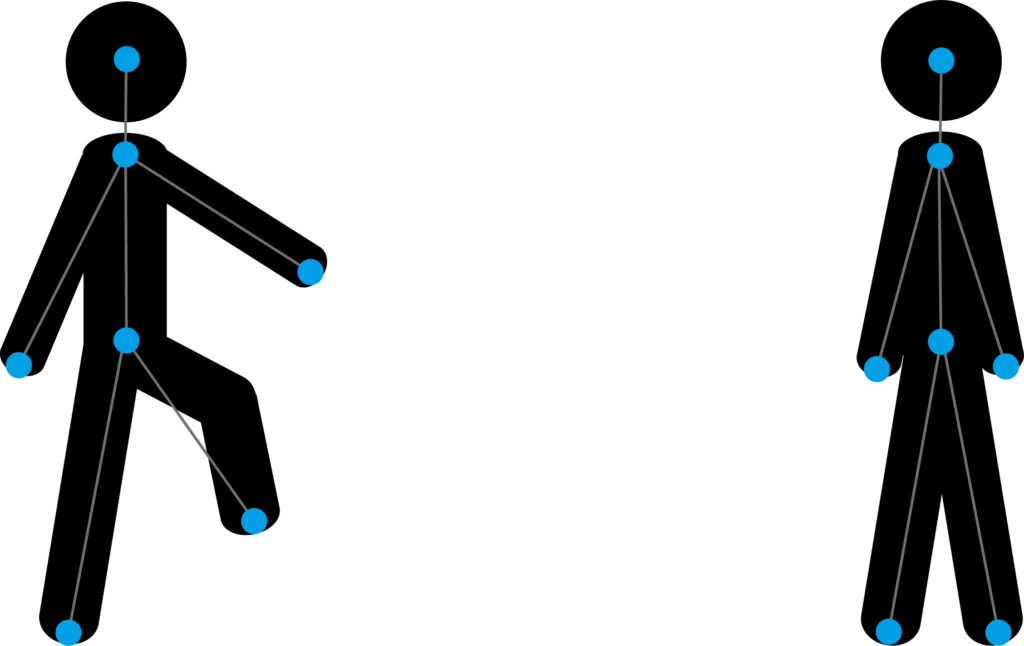
    These tools use deep learning to track body parts of animals and estimate their posture (here I’ll refer to them as tracking tools).

    By estimating posture, they reveal what posture an animal is in and use that for behavior analysis.

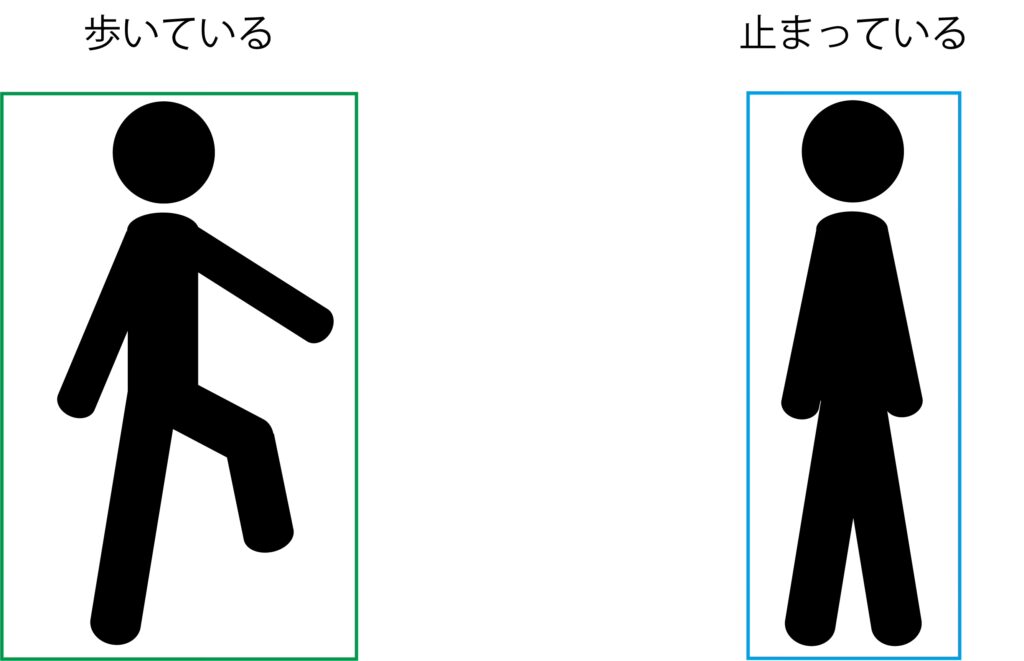
    YORU, by contrast, recognizes behavior using an object detection algorithm.
    In short, it does not track body parts; instead, it defines behavior directly from the appearance of the animal as it behaves.

    When people tell an apple from a mandarin orange, they rely on cues such as shape and color.
    Object detection excels at classifying objects, so it makes exactly this kind of appearance-based distinction.

    Applying this to animal behavior analysis means classifying animal behavior from its appearance.
    Within YORU, we call this a “behavior object.”

    Whereas tracking tools represent behavior as points and lines, YORU analyzes behavior by enclosing it in a bounding box.

    Advantages of defining behavior with object detection

    The advantages of object detection-based behavior analysis include:

    ・Errors are less likely as the number of individuals increases

    ・Less sensitive to the orientation of the animal

    ・Fast analysis speed

    ・Can capture behaviors that are hard to capture by tracking (such as a mouse crouching)

    and so on.

    It makes it easy to analyze the behavior of multiple individuals—a weak point of tracking tools—at a considerably lower computational cost.
    It can also easily analyze behaviors that are difficult to define from the positional information of body parts.

    Consider, for example, the act of opening and closing a hand.
    With a tracking tool, you would track the fingertips with a camera and define the hand as open or closed, but if the fingertips become hidden when the hand closes, tracking fails and the positional information can no longer be computed accurately.

    With object detection, however, the model looks at the overall shape of the open and closed hand, so it can capture the state accurately even when part of the hand is hidden.

    The same logic explains its robustness to larger numbers of individuals: with a tracking tool, as the number of individuals grows, you must assign each body part to the correct individual to capture each individual’s behavior accurately, whereas YORU analyzes only the shape of each individual and therefore requires no individual identification or assignment.

    Because analysis is fast, real-time analysis is possible, allowing you to control equipment when a particular behavior occurs and thus automate behavioral experiments.

    Disadvantages of defining behavior with object detection

    Of course, there are disadvantages as well:

    ・Cannot capture a sequence of behaviors

    ・Cannot identify individuals

    ・Cannot capture unknown behaviors

    ・Cannot capture behaviors that are hard to distinguish by appearance

    ・Provides no detailed information about the defined behavior

    These are precisely the strengths of tracking tools; rather than one approach being superior, the two complement each other’s advantages and disadvantages.

    Experimenters therefore need to choose the method appropriate to their situation.

    What makes YORU special?

    Having described the advantages and disadvantages of the object detection-based behavior analysis that underlies YORU, what exactly makes YORU special?

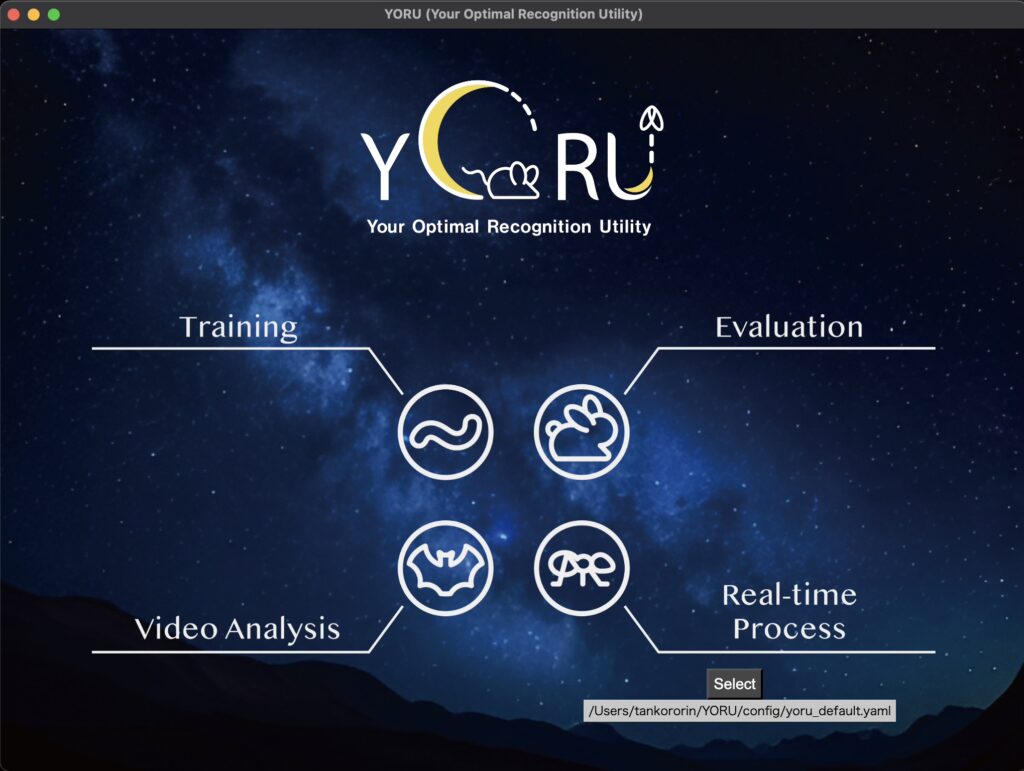
    Everything runs through a GUI

    YORU lets you perform behavior analysis without any programming.

    The same is true of tools like DeepLabCut and SLEAP, and it goes a long way toward making these analyses accessible to biologists.

    Design


    Unlike previous tools, YORU’s design doesn’t really feel like a research tool.

    Built-in real-time analysis

    Unusually for tools of this kind, YORU comes with a full GUI for real-time analysis.

    Building a real-time analysis system isn’t that difficult if you can program to some extent, but otherwise the barrier is quite high.

    With YORU, however, real-time analysis and even external triggering can all be done without any programming.

    Adaptable to a wide range of experimental setups

    The biggest hurdle in real-time analysis is figuring out how to combine the code that drives your own experimental apparatus with the analysis itself.

    YORU adopts a plugin system, letting you choose the program that controls your external device.

    In other words, you simply select the plugin that matches your own system.

    You can also write your own plugins: by wrapping the control program for your own apparatus in a plugin, you can easily link it to YORU’s real-time analysis.

    This makes for a remarkably easy-to-use system that no other tool offers.

    Closing remarks

    YORU has only just been released, and there are still rough edges in usability as well as gaps in the documentation.

    That said, as these are addressed over time, I am very much looking forward to seeing how it comes to be used.

  • The Keyword That Changes Your Life Might Just Be “Moving”

    I came across a book by Kenta Nagakura titled “People Who Move Around Succeed” at a bookstore, and decided to read it.
    In this post, I’d like to share my impressions.

    “People Who Move Around Succeed” by Kenta Nagakura

    Overall impressions

    First of all, this book is remarkably easy to read. I say that because I’ve never been much of a reader and I’m a fairly slow one at that, yet I got through this book with surprising ease.

    It usually takes me two or three days to finish about 200 pages, and quite often I lose interest partway through and give up altogether.
    This book, though, I managed to finish in about three hours in total.
    Personally, I was pretty amazed.

    I’ll try to avoid spoiling the content, but conveying my impressions requires introducing at least a minimum of it, so if you want to read the book with fresh eyes, you may want to skip this post.

    Centered on its keyword, “movement,” the book essentially says: “If you want to change your life, get moving!!!” (to put it far too simply)

    As the author himself notes in the preface, these ideas won’t be accepted by everyone, and criticism is surely to be expected.
    Still, I found them relatable, and since this is one valid way to live, I think it will resonate strongly with the right readers.

    There’s nothing dubious about the content; it reads as though the author is genuinely putting down what he truly believes.

    Also, a common failing of self-help books is that they tell you what you should do but say little about how to actually pull it off. This book has very little of that problem.

    Precisely because it gives a solid answer to “So what do I do starting tomorrow?”, I think many readers will come away feeling glad they read it.

    Where I agree and where I differ

    The book has six chapters, and my personal take is that I largely agree with all of them except Chapter 4, where I found quite a few points I couldn’t fully accept.

    Chapters 1 through 3 were written in a genuinely clear and accessible way.
    (What follows may come across as presumptuous, so please bear with me.)

    The critical view he takes of the world, and the fact that he writes both from a first-person perspective and from a bird’s-eye view, made the book very easy to follow.

    It touches on things we tend to forget in day-to-day life, and his perspective makes you think, “Yes, that’s exactly how it looks from the outside.” It prompted me to reflect on my own situation—whether I should change the life I’m living now, and what I might be missing.

    Chapter 4 lays out concretely what one should do, but the content is very much shaped by the author’s own vantage point, and honestly I found it hard to apply to myself.

    That said, it’s only hard to apply as-is; you can simply shift your perspective, and if anything it’s more than enough as a prompt to think up other options for yourself.

    As for the rest, my impressions are the same as for Chapters 1–3.

    My own thoughts after reading

    The title makes clear that “movement” is the theme, and the backstory is that the title resonated with me so strongly that I bought the book on the spot at the store.

    And the fact that my own thinking is fairly close to the author’s is, I think, one reason the book was such an easy read for me.

    You could call it a critique of living a conventional life.
    My own motto is that I want to live an enjoyable life and not the same life as everyone else, so I hope to live in a way that somehow avoids falling into the conventional mold.

    It’s something everyone has thought about at least once, and probably acted on at some point—but it made me think that our social structures and culture make it hard to do.

    Lately I’ve been questioning whether that’s actually good or bad.

    Books on how to succeed, to put it bluntly, tend to say that Japanese culture is hopeless, so go abroad! And that we should aim to break free from being pacified and kept in line, I suppose.

    This book is more logical, and of course doesn’t go so far as to say what I described above.
    Still, in the end, it does seem to suggest that breaking away from being an ordinary person is the path to success.

    And that’s probably true.
    So-called successful people are a minority, so becoming one requires breaking away from the majority.

    That said, it’s also a fact that society functions thanks to the culture and mindset of that majority.
    Why is Japan so safe? Why is general education so widely shared?

    I think it’s precisely because of the way Japan is—its culture, its systems, its ways of thinking.

    That’s why, although we tend to focus only on how Japan compares unfavorably with other countries, I’ve recently come to realize that there must be reasons things turned out this way, and advantages that come from it.

    In the book, the author also says that living abroad allowed him to see both the good and bad of Japan and the good and bad of other countries.

    It’s obvious, but it’s the kind of thing we easily forget.

    Rating

    My rating for this book is

    ★★★★☆

    .

    To change your life, the first step is learning that such a way of thinking exists.
    On that basis, this book is very easy to understand, and I think it also lays out guidelines for what to do next.

    That said, for people who don’t want to change their lives, the information may not be necessary.
    Since I can’t quite recommend it to everyone, I personally settled on four stars.

    It’s a very good book, and I personally enjoyed reading it a great deal.

  • Study Techniques from a Top-Ranked Science Student at a National University: How to Take Notes

    Study Techniques from a Top-Ranked Science Student at a National University: How to Take Notes

    People say all kinds of things about the study notes of smart people—that they’re beautiful, easy to read, and so on.
    But when you try to imitate that and take neat notes in class, it often ends up being nothing more than a copy of what’s on the board, or it takes too much time, and things just don’t go well.

    The most important thing about taking notes is finding and mastering a note-taking style that works for you.
    Here I’d like to write about note-taking techniques, using my own approach as an example.

    Rules for Taking Notes

    First of all, no matter how much you study note-taking methods, you won’t be able to put them into practice.
    What matters is deciding on your own set of note-taking rules.

    There are three important points to consider when setting these rules.

    • Keep it as simple and clear as possible
    • Are you the type who reviews notes later, or the type who memorizes on the spot?
    • How you categorize information

    Keep it as simple and clear as possible

    In situations where you’re taking notes during a class or lecture, information is basically flowing past you.
    To take notes under those conditions, the key is getting things down on paper quickly.

    That’s exactly why you need to keep up with the flow of information rather than making everything look pretty with a wide variety of colors.
    Taking notes isn’t the main task—taking in the information is.

    So your rules shouldn’t be the kind that make you stop and think, “Wait, which rule was that again?” They need to let you pick colors and decide how to write things intuitively.

    Are you the type who reviews notes later, or the type who memorizes on the spot?

    After class, you’ll probably use your notes when studying for exams.
    What you write in your notes changes depending on whether you use them like a textbook or as cues to jog your memory.

    If you use them like a textbook, you need to write down as much of the information from class as possible, which takes a corresponding amount of time.
    But since you can then study primarily from those notes, they’re extremely convenient later on.

    If you use them as memory cues, you filter the information down to a degree, which lets you concentrate on the class.
    The problem is that when you go to study later, you often need to consult your textbook or other materials.

    It may also depend on your teacher’s lecture style and the exams, but decide first and foremost which type you are.

    If you’re the type who can remember most of what was covered in class, the latter approach should be fine.
    If you’re someone who needs repetition to remember things, the former is probably better.

    What you shouldn’t do is decide based on things like “my notes look nicer this way” or “I feel uneasy leaving anything out.”

    How you categorize information

    Color-coding in your notes is really just a way of categorizing information.
    In other words, once you’ve sorted information into categories, all you have to do is assign a color to each one, and your color-coding rules are set.

    Before thinking about colors, you need to decide what kinds of information you actually need to distinguish.
    I’ll describe my own categorization scheme below.

    One way to categorize is by important versus unimportant information.
    Then, how finely do you divide things by importance?
    Two levels, three levels, or more?

    Besides importance, there are also headings, things the teacher said, things not in the textbook, supplementary information, and so on.

    If you decide in advance how to provisionally record exceptions when they come up, you can get through the moment without hesitating and then refine your rules afterward.

    If you set your rules with these key points in mind, you’ll end up with the ultimate note-taking method tailored to you.

    How I Take Notes

    I’ve been speaking conceptually up to now, so let me offer my own note-taking method as a concrete example.

    First, I’m the type who memorizes on the spot, so I treat my notes as supplementary and put the emphasis on absorbing information during class.
    Since I don’t want to spend much time writing, I keep my rules extremely simple.

    My categorization is just whether information is important or not.
    Important information goes in red, everything else in black.

    Because I write a lot in red, I use an erasable ballpoint pen (FriXion) for it.

    For information that might be important, or things I realize are important after writing them down, I underline them in red.

    Anecdotes the teacher mentions are useful for recalling the content, so I jot them down small in black near the related material.

    Books like “Note-Taking Techniques of University of Tokyo Students” get published, and they usually tell you to take beautiful notes—but that works for some people and not for others.

    It didn’t work for me.
    (My handwriting isn’t nice to begin with, so I never got into the habit of reviewing my notes when studying for exams.)
    And since using many colors just made me hesitate, I found my own approach by accepting that my notes are simply memos.

    Even if your notes aren’t beautiful, you can still get good at studying.

    There’s no single correct way to take notes that works for everyone, so try various approaches and find a style that suits you—and that you enjoy!!

  • From GitHub Basics to Publishing Your Code Alongside a Paper

    Here are the slides from a talk I gave on how to use Git and GitHub.

    The slides cover everything from hands-on operations in GitHub to the steps needed to make your program code available alongside a published paper.

    Sharing paper data and analysis code is increasingly expected these days.
    Beyond that, managing code with GitHub has become an essential part of working on collaborative research.

    [Updated January 15, 2024] https://www.slideshare.net/slideshow/embed_code/key/vzfmHD9i6I15wI

    From GitHub basics and code management to publishing your program code with a paper from Hayato Yamanouchi

    The same material is also posted on my personal site.

    Hayato M. Yamanouchi’s personal site

  • What to Do When You Spill a Drink on Your Laptop

    What to Do When You Spill a Drink on Your Laptop

    If you work at a desk with a laptop, sooner or later you will probably spill a drink on it.
    I once spilled a drink on my own MacBook Pro and nearly lost the files I needed to graduate.
    So here I want to share what to do when your computer gets soaked.

    What to do right after a spill

    First of all, when you spill a drink, avoid doing anything careless like turning the computer on.

    Instead, shut the power off immediately and stand the computer up on the side where the drink was spilled, so that no more liquid seeps inside or spreads to areas that are still dry.

    Photo

    Once you have confirmed that the surface of the computer is dry (after several hours to a day), try turning it on and check its condition.

    What to do next

    Depending on the condition, there are several options.

    Coverage from the retailer or manufacturer

    Some manufacturers’ warranties include accidental damage coverage, so check whether your case qualifies.

    If you can use this kind of coverage, it is likely to be the cheapest way to get your machine back.

    With a standard manufacturer’s warranty, liquid damage is very likely to be excluded.
    That said, many manufacturers still accept repair requests, so it is worth asking for a paid repair.

    Computer repair shops

    Many computer repair shops handle water-damaged machines.

    Some also work on MacBooks, so it is well worth considering this option.

    They can also inspect the inside of your computer, so even if you only spilled a small amount and simply want peace of mind, they will check it for you.

    And if a repair is needed, they can handle a wide range of work, so the chances of recovery are very high.

    Why leaving it alone is a bad idea

    Even after a spill, a computer will often work again a day later.

    Even so, I do not recommend just leaving it at that.
    If moisture has reached the circuit board, it can cause a sudden short circuit or corrode the board.

    You often hear about machines that worked for a while after getting wet and then suddenly died, so get the computer repaired as soon as you can.

    Acting early may mean a simple cleaning is enough, and it keeps the cost down.

    What you can do in advance, just in case

    When a computer gets soaked, recovering the data is often difficult.

    For exactly that reason, back up your computer regularly.

    Computers tend to break down precisely when you need them most, such as when you are up against a thesis deadline.

    Not being able to retrieve your data at a moment like that is a serious problem.
    I have been in exactly that situation myself….

  • How to Install SLEAP [Updated February 2024]

    How to Install SLEAP [Updated February 2024]

    Here I’d like to describe how to install SLEAP, a machine learning-based tool for tracking animal body parts.

    DeepLabCut is the most widely used tracking tool, and I have written about how to install it in the past, as have many other people.

    For SLEAP, however, there are currently few articles available in Japanese.
    SLEAP has many advantages over DeepLabCut, so I decided to write up the installation procedure to make it a viable option for more people.

    SLEAP’s documentation, from installation to usage, is extremely well organized and comes with videos, so anyone comfortable with English should find it easy to get started.

    The SLEAP paper is available here

    The official SLEAP website is here

    The SLEAP GitHub repository is here

    Introduction

    First of all, regarding the approach described in the official SLEAP installation guide,

    mamba create -y -n sleap -c conda-forge -c nvidia -c sleap -c anaconda sleap=1.3.3

    which sets up the environment, installs the packages, and handles everything else in a single command: I tried this on several computers, but in every case it stalled indefinitely during the environment setup and never completed successfully.

    So here I introduce an alternative installation method, also suggested by the developers.

    Installation

    We will basically follow the installation instructions on the official SLEAP website.

    Environment

    ・Windows 11 Pro
    ・Verified on an NVIDIA 3080
    ・SLEAP 1.3.3
    ・Python 3.7.12

    Downloading the files

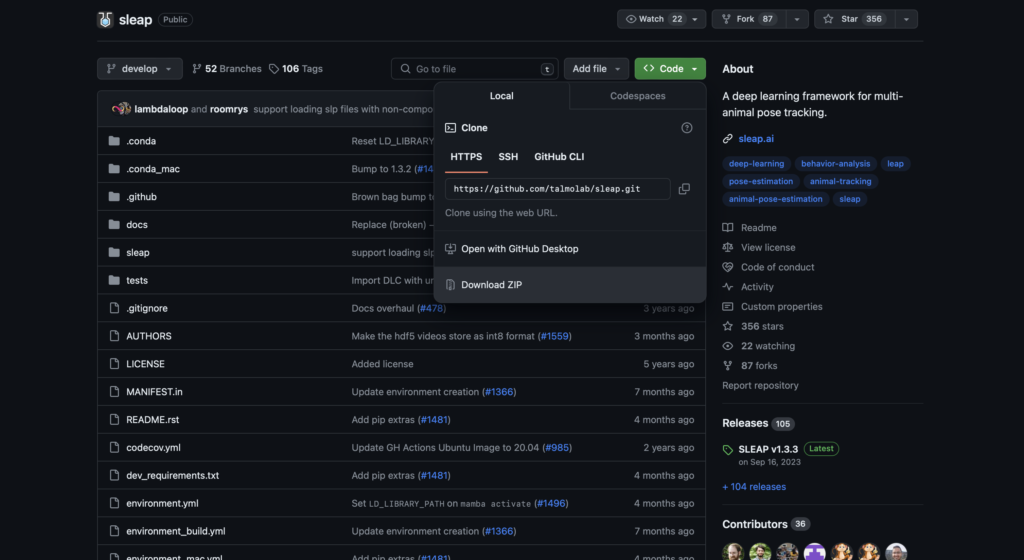
    First, download the files from the SLEAP GitHub repository to your computer.

    If you are using Git, run the following command.

    git clone https://github.com/talmolab/sleap

    If the git command is not available, either install git or download the files directly from GitHub.

    Installing the GPU driver

    Install the NVIDIA driver.
    (Skip this step if it is already installed.)

    Installing Anaconda

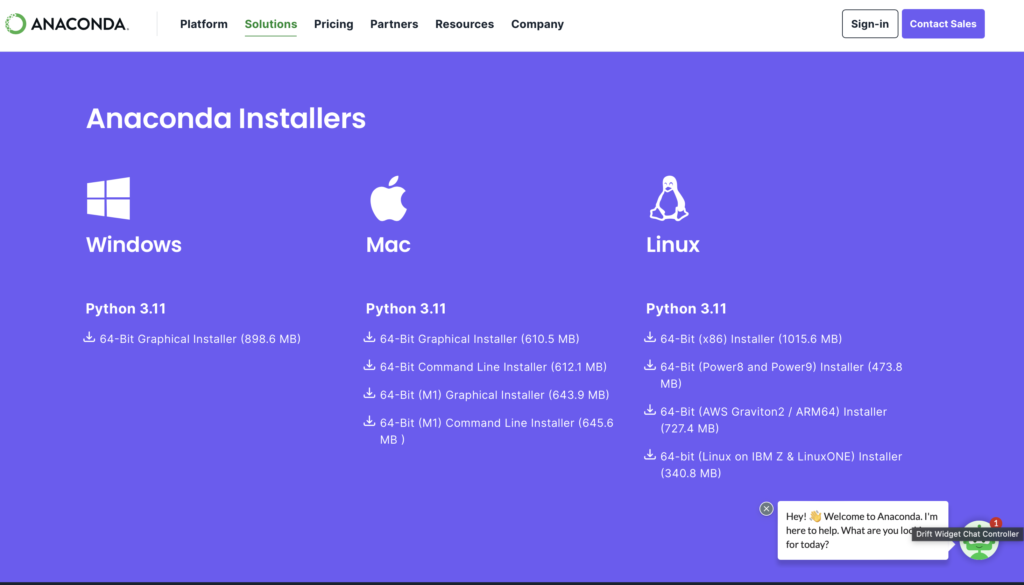
    Next, download and install the Windows 10 64-bit version from the Anaconda website.
    Click Free Download on the Anaconda site and scroll down; you should see a screen like the one below.
    Install the Windows installer on the far left.

    Once Anaconda is installed, you should find “Anaconda Prompt” in your Windows app list.
    We will use it to run the commands below to create the virtual environment, install SLEAP, and launch it.

    Creating the virtual environment and installing

    Next, run the following commands to create the virtual environment and install SLEAP.
    The environment will be named “sleap”.

    cd sleap
    conda env create -f environment.yml -n sleap

    Note that the commands above work on computers with a GPU;
    on computers without one, use the following commands instead.

    cd sleap
    conda env create -f environment_no_cuda.yml -n sleap

    That completes the installation.

    Verifying the installation

    Activate the virtual environment and launch SLEAP with sleap-label.

    conda activate sleap
    sleap-label

    You need to activate the virtual environment (the conda activate sleap command) every time you reopen Anaconda Prompt.

    After activation, the prompt should change from (base) to (sleap).

    If SLEAP launches, the installation was successful.

    Checking version information for reporting in a paper

    To check the version, activate the sleap environment and run the following command.

    python -c "import sleap; sleap.versions()"

    This will output

    SLEAP: 1.3.3
    TensorFlow: 2.7.0
    Numpy: 1.21.5
    Python: 3.7.12
    OS: Windows-10-10.0.22621-SP0

    showing the SLEAP version information and related details.

    You can also check whether SLEAP can use the GPU with

    python -c "import sleap; sleap.system_summary()"

    which should produce output like the following when the GPU is available.

    GPUs: 1/1 available
      Device: /physical_device:GPU:0
             Available: True
           Initialized: False
         Memory growth: None

    In future posts, I hope to walk through how to actually use SLEAP.

    Bonus

    For those unsure which computer to buy, I’ve started offering PC purchase consultations on Coconala!

    あなたの要望に合わせてパソコンを選び、提案します パソコン選びに困っている方々へ!様々な目的に対応できます!

    I often pick out computers and give advice on them, and many friends have told me I could make money doing PC consultations.
    That inspired me to give it a try!

    I’ll recommend a machine that fits both what you want to use it for and your budget.
    In particular, I’ve chosen and used many computers for machine learning.

    And if you’d like, I’m happy to advise you on what to look for the next time you buy a computer.

    Machines I’ve picked out so far include lab analysis computers, everyday-use computers, computers for game streaming, computers for incoming university students, computers that can run CAD for architecture students, and simple stopgap machines.

    I use both Mac and Windows, so I can talk about and recommend either one!

    Please feel free to make use of it.

  • A Roundup of Drosophila Research Tools and Databases

    Here I’ve compiled a memo-style list of research tools useful for working with the fruit fly (Drosophila).
    If anything is missing, or if there is a tool you would like me to add, please leave a comment on the site or contact me at haya.m.yamano.neuro@gmail.com.

    This page is still under construction, so the information will keep growing over time.

    Last updated: December 1, 2023

    Databases

    FlyBase

    URL: https://flybase.org

    A comprehensive database for Drosophila. In addition to gene sequences and expression data, it provides access to research papers and information about the Drosophila research community.

    FlyWire

    URL: https://flywire.ai

    NeuronBridge

    URL: https://neuronbridge.janelia.org

    FlyLight

    URL: https://www.janelia.org/project-team/flylight

    FlyCircuit

    URL: https://www.flycircuit.tw

    neuPrint

    URL: https://neuprint.janelia.org

    SCope

    URL: https://scope.aertslab.org

    Fly Cell Atlas

    URL: https://flycellatlas.org

    Paper:

    Stock Centers

    Bloomington Drosophila Stock Center

    URL: https://bdsc.indiana.edu

     The Drosophila stock center at Indiana University in Bloomington, USA.
    You can search not only by genotype but also by stock number (the numbers beginning with BL).

    A wide variety of lines are available here, including GAL4, UAS, and RNAi lines.

    Vienna Drosophila Resource Center

    URL: https://shop.vbc.ac.at/vdrc_store/

     The Drosophila stock center at the Institute of Molecular Biotechnology (IMBA) in Austria. It holds an especially large collection of RNAi lines.

    KYOTO Drosophila Stock Center

    URL: https://kyotofly.kit.jp/cgi-bin/stocks/index.cgi

     A stock center at the Kyoto Institute of Technology in Kyoto, Japan. It is the largest Drosophila stock center in Japan; you can download the stock list from the site and search collectively by line.

    KYORIN-Fly : Drosophila species stock center

    URL: https://shigen.nig.ac.jp/fly/kyorin/

     A Drosophila stock center at Kyorin University in Japan. It maintains a wide range of Drosophila species, and mutants of species closely related to Drosophila melanogaster can also be obtained here.

    Behavioral Analysis Tools

    DeepLabCut

    URL: http://www.mackenziemathislab.org/deeplabcut

    Paper: Mathis A, Mamidanna P, Cury KM, et al. DeepLabCut: markerless pose estimation of user-defined body parts with deep learning. Nat Neurosci. 2018;21(9):1281-1289. DOI:10.1038/s41593-018-0209-y


    SLEAP

    URL: https://sleap.ai

    Paper: Pereira TD, Tabris N, Matsliah A, et al. SLEAP: A deep learning system for multi-animal pose tracking. Nat Methods. 2022;19(4):486-495.
    DOI:10.1038/s41592-022-01426-1

    UMATracker

    URL: https://ymnk13.github.io/UMATracker/

    Paper: Yamanaka O, Takeuchi R. UMATracker: An intuitive image-based tracking platform. J Exp Biol. 2018;221(16):1-5.
    DOI:10.1242/jeb.182469

    Ctrax

    URL: https://ctrax.sourceforge.net

    Paper: https://www.nature.com/articles/nmeth.1328

    FlyTracker

    URL:

    Paper:

    ID Tracker

    URL:

    Paper:

    TRex

    URL:

    Paper: https://elifesciences.org/articles/64000

    JAABA

    URL:

    Paper:

    Other Resources

    Brain and VNC template (JRC 2018 Brain templates)

    URL: https://www.janelia.org/open-science/jrc-2018-brain-templates

    Color-Depth MIP

    URL: https://www.janelia.org/open-science/color-depth-mip

    Dissection and Immunostaining Protocols

    URL: https://www.janelia.org/project-team/flylight/protocols

    Here you can find videos on dissecting adult and larval Drosophila, along with immunostaining protocols.

  • Improving Your JSPS Research Fellowship (DC1, DC2) Application [Advice from a Successful FY2024 DC Applicant]

    The results for the JSPS Research Fellowships (DC1 and DC2) were announced at 14:00 on Wednesday, September 27, 2023.

    I was one of the students who applied, and I am happy to report that I was selected.
    Word going around on X (formerly Twitter) was that this year’s acceptance rate was lower than usual.

    Apparently the initial acceptance rate was around 14%, or about 17% including the second round of selections.

    I had heard that the rate is usually close to 20%, so when I saw the numbers my first thought was, “Seriously?”

    Through this application cycle I read a number of other people’s JSPS applications and wrote my own, so here I’d like to summarize the things worth keeping in mind to improve your chances even a little.

    I think this applies not only to JSPS applications but to grant proposals, job application essays, and any writing meant to be read by others, so I hope you’ll read on.

    What matters is what lies beyond the application

    First, the key to writing an application is conveying what you want to say within a limited amount of space.

    An application explains your research and argues for its importance: this is who I am, these are the things I can do, and therefore I can achieve this goal. So please fund me.

    In other words, you need to keep sight of what your writing is ultimately for.

    While writing, it’s easy to get caught up in immediate concerns—producing elegant prose, writing something your advisor won’t complain about—and lose sight of what an application fundamentally is.

    It isn’t self-satisfaction: there are people who read and evaluate it, and score it accordingly.
    That is what clearly distinguishes it from an exam, and it’s precisely why there is no single correct answer.

    My impression is that many people who have spent their lives taking tests with right answers suddenly hit a wall when faced with an application, unsure what to write or what counts as correct.

    Even while writing, you need to keep in mind who the application is written for.
    For that reason, writing a few applications to other funding bodies before the JSPS one and having people read them makes a striking difference in how readable your writing becomes.

    The keywords are “logic” and “specificity”

    Logic

    The two things I paid the most attention to when writing my JSPS application were logic and specificity.

    Logic means that your argument is consistent and that each topic connects to the next.
    You need to think about these connections at multiple scales: between sentences, between paragraphs, and across the application as a whole.

    To put it in more practical terms,
    logical writing is writing in which the reader finds what they want to know, in the order they want to know it.
    When this is done well, the content flows effortlessly into the reader’s mind.

    The point is to think from the reader’s perspective.
    No matter how logical you think your argument is, that logic may not land with your reader.

    Guides to writing JSPS applications often recommend inserting phrases like “in other words” or “the details are described below,” but the essential purpose of these is to give the reader signposts that make the connections in your text easy to follow.

    Opinions differ widely on whether such phrases are necessary, but one thing I can say is this: if leaving them out makes your structure unclear, put them in, even at the cost of precious character count.

    Specificity

    Specificity means, quite literally, providing exactly as much information as the reader needs.

    You’ve probably heard people say, about applications or research talks,
    “My research requires so much background that I just can’t keep it short.”

    I’ve thought the same thing myself many times before a ten-minute conference talk—there’s no way this fits in ten minutes.

    But even in a talk you’ve confidently packed with content, it often turns out that there was a lot of information the audience didn’t need and almost none of what they actually wanted to know.

    In other words, you haven’t decided what to keep and what to cut.

    To make those decisions, first determine the single thing you most want to convey.
    Then keep whatever is needed to explain that core point and discard whatever isn’t. That is how you achieve specificity.

    Applications like the JSPS one require you to describe your research and yourself in a genuinely tiny amount of text.
    People often say you should divide the JSPS funding amount by the character count of the application to calculate the value of a single sentence.

    I think the point of that exercise is to get you asking: is this sentence really worth that much money? If not, rewrite it.

    Background explanation is a third-person account, and while it’s necessary to make your own work stand out, the text itself describes other people’s research and is therefore low in value.
    Whether you keep it to a minimum or find some other value in it is up to you.

    Through this kind of revision, the content becomes refined.

    So far I’ve talked about specificity while only discussing cutting material, but the real point is to condense the content and raise the specificity of each sentence to just the right level—no more, no less.

    Throughout the process I kept logic and specificity constantly in mind, periodically stopping to reread and rewrite.

    Show it to others early

    One of the most important points is to have other people read your application early.

    Some people wait until it’s finished and they’re satisfied with it, then show it to someone a week before the deadline—but honestly, that’s a waste.

    Showing your draft to others is about confirming that you’re heading in the right direction and getting feedback, not just getting corrections.

    As people often say, the quality of a JSPS application depends on how many people have read it: you gain new insights, and sometimes your fundamental way of thinking changes.

    Ideally, aim to have someone other than your supervisor read it at least three weeks before the deadline.

    Don’t stare at your application nonstop

    When application season comes around, I often saw people put their experiments on hold to focus entirely on their proposals.
    It’s true that you need to invest a fair amount of time, and since you revise it over and over, it ends up eating up an enormous number of hours.

    That said, once you’ve written a decent draft, there’s no point in endlessly rereading it and burning time for nothing.
    In fact, you should leave the draft alone for a while before you go back and revise it.

    An application is an important document with your career riding on it.
    But it doesn’t get better in proportion to the time you pour into it. The real challenge is producing the best possible document as efficiently as you can.

    Rather than being glued to your computer, keep your experiments moving along, or even take a break to clear your head. You’ll write with a much cooler eye.

    I didn’t just write at the university; I would take my laptop to cafes and other places, changing the setting often as I wrote.

    Closing thoughts

    This year’s provisional acceptance rate is said to be around 14% at the first round of screening.
    Put another way, 86% of applicants were not selected for a JSPS fellowship.

    Since the vast majority of applicants aren’t selected, there’s no need to be more discouraged than necessary about not making the cut.

    At the same time, those who were selected got their place at the expense of many other people’s dreams and livelihoods.
    Of course, the selection reflects a real evaluation of your research as it stands, but beyond that, it carries the responsibility to work twice as hard from here on.

    I want to keep this in mind myself and keep pushing forward with my research.